The problem.
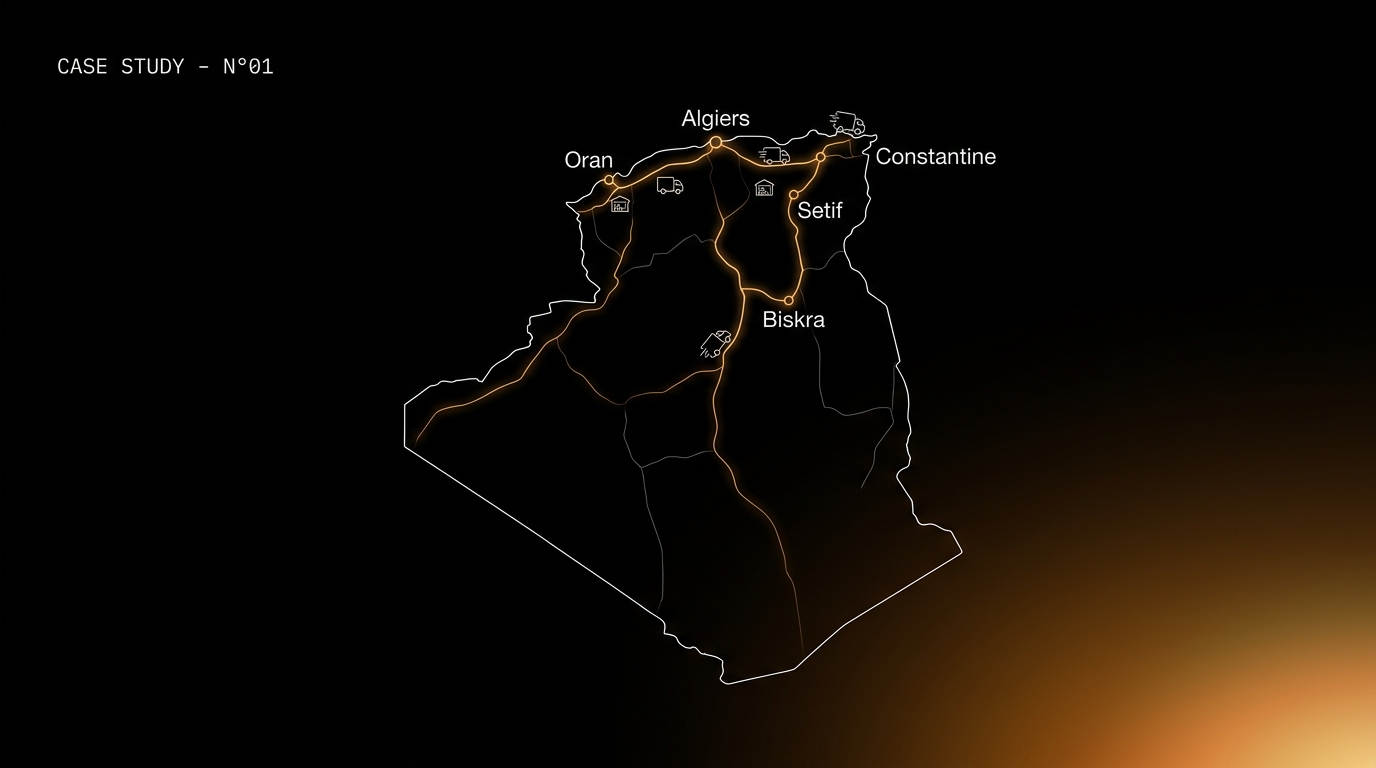
Distribution and wholesale companies in Algeria run one of the most operationally complex businesses in the country — dozens of SKUs, multiple warehouses, fleets of delivery vehicles, mobile sales reps with truck-loaded stock, cash handling, credit management, and reporting across all of it. Most were running this on Excel, paper, or imported software that did not understand local payment methods, Arabic RTL, or the reality of operating in a network-intermittent environment.
The founders of TrackSera came to Symloop in 2023 with a clear but ambitious brief: build the distribution management platform Algeria needed, ship it as a proper SaaS, and engineer it so it would still work when the driver has no 4G signal in the middle of a rural delivery route.
The product had to be multi-tenant from day one, trilingual (Arabic, French, English) with full RTL support, mobile-first for the field operations, and desktop-first for the office. And it had to be priced for the Algerian market — from free tier up to enterprise — without cutting on engineering quality.
Four products. One platform.
The web application runs the entire back office: order management, purchasing, stock across multiple warehouses with expiry-date tracking, client database with category-based pricing, cash register per user with daily reconciliation, and a full reporting engine exporting to PDF and Excel. Multi-tenant architecture with isolated data per tenant. Professional PDF invoicing, delivery notes, and a purchase-order workflow tied to supplier debt tracking.
Tracksera Vendeur — the seller Android app — lets sales reps take orders on the road, view client history, and manage quotes without a laptop. Works offline, syncs when connectivity returns.
Tracksera Livreur — the driver Android app — handles delivery routes with live GPS tracking, turn-by-turn directions, proof-of-delivery capture (photo + digital signature), and real-time status updates back to the office.
Tracksera Cashvan — the mobile-sales app — loads stock onto a truck, sells direct to clients, prints invoices via Bluetooth receipt printer, handles returns, and reconciles cash at end of day. All offline-capable.
Built to run where the network sometimes does not.
Backend — Node.js + PostgreSQL multi-tenant architecture with strict tenant isolation at the database level. Redis for session and rate-limit layers. REST API designed for both web and mobile consumers, versioned from day one. Background workers for invoice generation, report exports, and scheduled syncs.
Web frontend — Next.js with server-side rendering for the public marketing pages, client-side app for the authenticated dashboard. Full i18n with next-i18next for Arabic RTL, French, and English. Chart.js for analytics, custom PDF renderer for invoices.
Android apps — Native Android (Kotlin), not Flutter or React Native. The field operations needed hardware-level control: Bluetooth thermal printer integration for Cashvan invoices, GPS background tracking for Livreur, and SQLite local databases with custom sync conflict resolution for offline-first operation.
Infrastructure — Dockerized services behind an Nginx reverse proxy. Automated PostgreSQL backups, structured logging, and uptime monitoring. Deployed on a managed cloud platform with staging and production environments separated.
The engineering problems that mattered.
- 01
Offline-first, not offline-fallback
Most apps that claim offline support actually break the moment connectivity drops. For TrackSera, the mobile apps had to assume offline by default — a driver in rural Algeria has no signal for hours. We built a local SQLite layer with an event-sourced queue, conflict-resolution rules per entity type, and a background sync worker. The apps are fully operational without network.
- 02
Multi-tenant from day one
Every distribution company is a tenant with its own data, users, pricing plans, and configuration. Tenant isolation at the database level, row-level security policies, and tenant-aware API authentication — all built in from the first commit, not retrofitted.
- 03
Arabic RTL everywhere
Arabic is not an afterthought — it is the default language for most operators. Full RTL support in the web dashboard, in every PDF invoice, in every Android screen, with proper Arabic number formatting, Islamic calendar dates, and bi-directional text handling where Arabic and French mix.
- 04
Bluetooth thermal printing from Android
Cashvan sellers print invoices on truck-mounted Bluetooth thermal printers. No library handled this cleanly for the local printer models, so we built the ESC/POS protocol integration ourselves and maintained our own driver for three printer manufacturers.
What shipped, what it runs on.
- 01
Platform went live in 2024 and has been running in production since — currently serving distribution and wholesale operators across Algeria.
- 02
Four-tier pricing model (Free, Starter, Pro, Business) live on the platform with self-service billing via CCP and BaridiMob — the two most common payment methods in Algeria.
- 03
Three Android apps published as APKs for direct installation on operator devices, with auto-update mechanism that doesn't require Play Store distribution.
- 04
Website (tracksera.com) delivers product information in Arabic, French, and English, with full RTL and SEO optimization for the Algerian distribution market.
What buyers usually ask about this project.
01How long did it take to build TrackSera from scratch?+
The full platform — web application plus three Android apps — took 18 months end-to-end with a team of 4 senior engineers. The first mobile app was in production at month 8. Multi-tenant infrastructure, offline sync, and Bluetooth printing integration were the longest-lead engineering items.
02Can you build a similar multi-tenant SaaS for my industry?+
Yes. We engineer multi-tenant SaaS platforms with offline-capable mobile apps across distribution, wholesale, fintech, healthcare, and industrial logistics. The architecture patterns transfer — tenant isolation, offline-first sync, RTL support, Bluetooth hardware integration, multi-warehouse stock — what changes is the domain logic.
03Why native Android instead of Flutter or React Native?+
For field operations with Bluetooth receipt printers, background GPS tracking, and unreliable connectivity, native Android (Kotlin) gave us hardware-level control that cross-platform frameworks do not. For products where hardware integration is lighter, Flutter or React Native is often the better economic choice — we ship both.
04How does offline-first architecture work in production?+
Each mobile app has a local SQLite database, an event-sourced queue for all write operations, and a background sync worker. Conflict resolution rules are defined per entity type. The apps are fully operational without network — orders, deliveries, and invoices all work offline. When connectivity returns, everything syncs.
05Does the case study cover multi-tenant security and data isolation?+
Yes. Tenant isolation is enforced at the PostgreSQL level with row-level security policies, not at the application layer. Every API request is authenticated and tenant-scoped. Backups are per-tenant. This is how Symloop builds every multi-tenant SaaS — isolation from the first commit.
06Can I see the TrackSera product live?+
Yes. Visit tracksera.com for the marketing site and a free 14-day trial of the SaaS. The three Android apps are available as APKs linked from the site.