Every twelve months a new round of think pieces declares that AI is about to replace doctors. The argument is always the same: large language models can pass medical board exams, image classifiers can detect tumors at superhuman accuracy, and any minute now the diagnostic profession will collapse. None of it has happened. None of it is going to happen on the timeline anyone is selling.
The actual story of clinical AI in 2026 is much less photogenic and much more useful. AI is not in the consulting room making diagnoses. It is at the desk next door eliminating the forty per cent of a doctor's working day that is spent on documentation, coding, prior authorizations, and discharge letters. That is the entire production reality. That is also where the entire near-term healthcare economic gain lives.
This brief is the engineering view from a team that has shipped clinical AI into Algerian and MENA hospitals. It explains why the doctor-replacement narrative is structurally wrong, what is actually shipping in production, and what an Algerian healthcare system should build first.
Why "AI replaces doctors" stays a fantasy
Diagnosis is not what doctors are paid for. Doctors are paid for accountability under uncertainty in a regulated, litigated, life-and-death context. A model can match or exceed a radiologist on a benchmark dataset and still not be allowed to sign a report, because nobody — patient, hospital, insurer, ministry of health — accepts a non-human signature on a clinical decision. That regulatory wall is not technical. No improvement in model accuracy will move it.
The second wall is liability. The moment an autonomous system makes a wrong diagnosis, somebody has to be sued. No vendor of any size has agreed to take that liability, and they are not going to. Until the legal architecture of medical responsibility changes — which is a generational shift, not a software release — autonomous diagnostic AI is locked out of the room where the decision happens.
The third wall is the one nobody talks about: doctors do not actually want to be replaced at the part of the job they like. They want to be relieved of the part they hate. The willingness to adopt AI inside a hospital is shaped almost entirely by which forty per cent of the day it removes.
The forty per cent nobody photographs
A general practitioner in an Algerian hospital spends roughly four hours of an eight-hour day on documentation. Patient notes, prescription paperwork, social security forms, hospital admission and discharge letters, prior authorization requests for procedures, and the endless coding of visits for billing. The clinical encounter — the part that requires a medical degree — is the smaller part.
In private specialist clinics the proportion is even worse. Cardiology and oncology consultants in our engagements report between fifty and sixty per cent of their working hours spent on text — most of it the same text, written slightly differently, for the fifteenth patient that week.
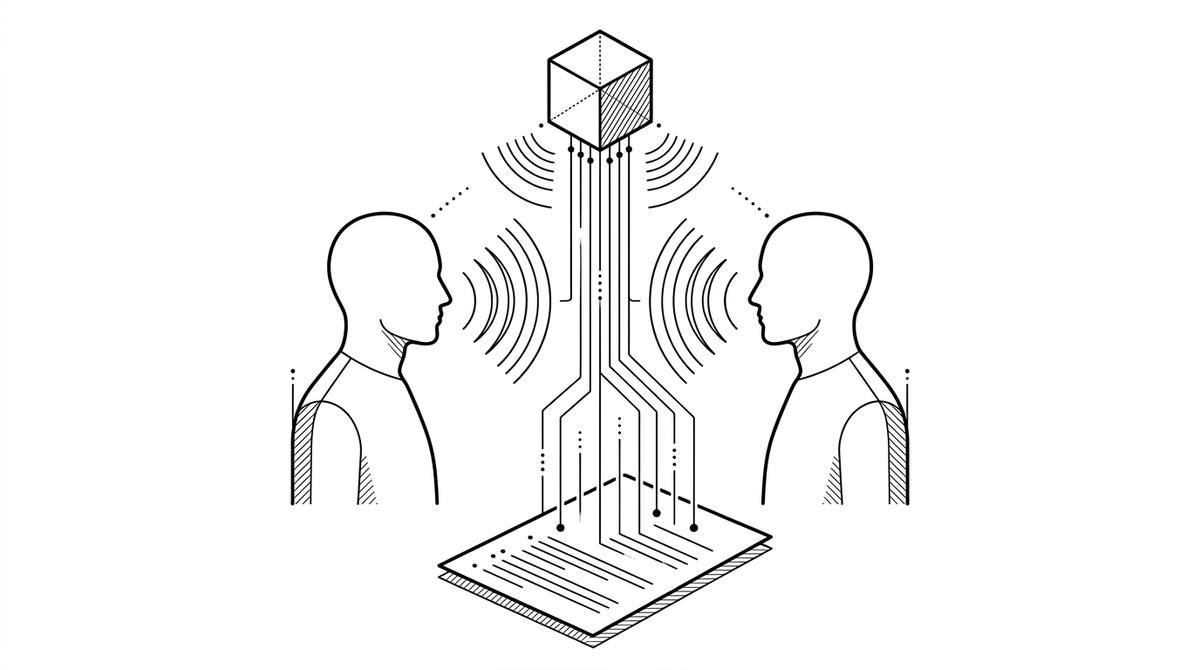
This is the four hours that AI can absolutely remove. And removing it does not require a model that passes the medical board exam. It requires a much narrower system that listens to a doctor-patient conversation, structures it into the format the hospital information system expects, and waits for the doctor to confirm or correct it.
What clinical AI actually ships in production
The clinical AI products that are running in real Algerian and MENA hospitals today fall into a small number of categories — and none of them touch diagnosis. Ambient AI scribes are the first: a microphone in the consulting room, a model that listens to the conversation, and a structured note that lands in the electronic medical record by the time the patient leaves. The doctor confirms or edits. Time saved per consultation: between four and seven minutes. Across a fifty-patient day, that is the difference between leaving the hospital at six and leaving at eight.
Document intelligence on incoming paperwork is the second. Insurance forms, lab reports from external providers, scanned hand-written referrals, faxed documents from regional clinics — all of it gets ingested, parsed, and pre-filled into the hospital system. The administrative staff approve rather than transcribe. Hospitals running this report a 70 to 85 per cent reduction in data-entry headcount needed for the same intake volume.
Coding and billing assistance is the third. Medical coders are scarce in Algeria and slow everywhere. A model trained on the local insurance and social security coding systems can suggest the right codes for a visit in real time, with the human coder reviewing instead of authoring. The fee schedules are stable enough for this to work and the ROI is direct because the alternative is unfilled coder positions.
Triage and routing in emergency departments is the fourth. Not diagnosis — routing. Which patient should be seen first based on the presenting complaint, the vital signs, and the historical data. The model never makes the call; it orders the queue, and a triage nurse confirms.
The Algerian and MENA opportunity is bigger than the headline
Algeria has roughly 1.7 doctors per thousand inhabitants — about half the OECD average. The gap is not going to close through training new doctors at the speed required. It will partially close through removing administrative load from the doctors who already exist. Every doctor relieved of two hours of paperwork per day is, in capacity terms, one fifth of an additional doctor without recruiting one.
Multiply that across the public hospital network and the math becomes hard to ignore. A clinical AI program targeting documentation and coding load has a defensible case for adding the equivalent of several thousand doctor-days of capacity per year, at a fraction of the cost of training new doctors. None of that capacity comes from replacing anyone. It comes from giving back the part of the day that should never have been clinical work in the first place.
The same logic applies across MENA. Saudi Arabia's Vision 2030 healthcare investments, the UAE's digital health push, Egypt's universal coverage programs — every one of these is ultimately blocked by the same documentation tax on clinical staff.
What an Algerian hospital should build first
If you run a hospital in Algeria and want to deploy clinical AI in 2026, the order of operations is now well understood. First: ambient AI scribe for outpatient consultations, in French and Algerian Arabic. This is the highest-impact, lowest-risk starting point. The model never makes a clinical decision, the doctor confirms every note, and the time saved is immediate and measurable.
Second: document intelligence on incoming external paperwork. This is administrative, not clinical, so the regulatory bar is lower. The ROI is fast because it removes salaried headcount from a process that adds no medical value.
Third, after the first two are stable: assisted coding for billing and insurance. This is where the cash flow improvement shows up at the hospital director's desk and where the project quietly funds the rest of the AI program.
Do not start with diagnostic imaging AI. Do not start with predictive analytics on clinical outcomes. Do not start with chatbots replacing nurses. All of those are real products in the long run but every one of them has an operational, regulatory, or trust barrier that will stall a hospital's AI program before it has built the muscle to deploy anything at all.