
Every growing Algerian company hits the same wall. Revenue is climbing, operations are getting complex, and somebody needs to make technical decisions — which system to buy, which vendor to trust, how to integrate, what to build, what to scrap. That somebody is a CTO. **And there are fewer than 200 of them in the entire country willing to work for an SME.**
This brief is not about replacing engineers with chatbots. It is about a specific, buildable system — an AI operations backbone — that handles the **five CTO functions** most Algerian companies actually need, without requiring a human who costs 400,000 dinars a month and takes six months to find.
The CTO gap in Algeria is structural, not temporary
Algeria produces roughly 8,000 computer science graduates per year. Of those, fewer than 500 stay in the country with enterprise-grade experience after five years. Of those 500, fewer than 200 are willing to work for an SME instead of a multinational, a ministry, or their own startup. **That is the entire pool.** And every growing company in the country is fishing from it.
The result is predictable: most Algerian SMEs between 30 and 300 employees **have no technical decision-maker at all**. The founder makes technology choices based on what the last vendor told them. The IT person — if they have one — maintains servers but does not architect systems. Nobody evaluates vendors independently, nobody reviews code, nobody plans the technology roadmap. Every technical decision is reactive, not strategic.
Hiring your way out of this is not realistic. The math does not work for a company doing 50 million dinars in revenue. An AI operations backbone is not a luxury alternative — **it is the only alternative that exists at this scale.**
What an AI operations backbone actually is
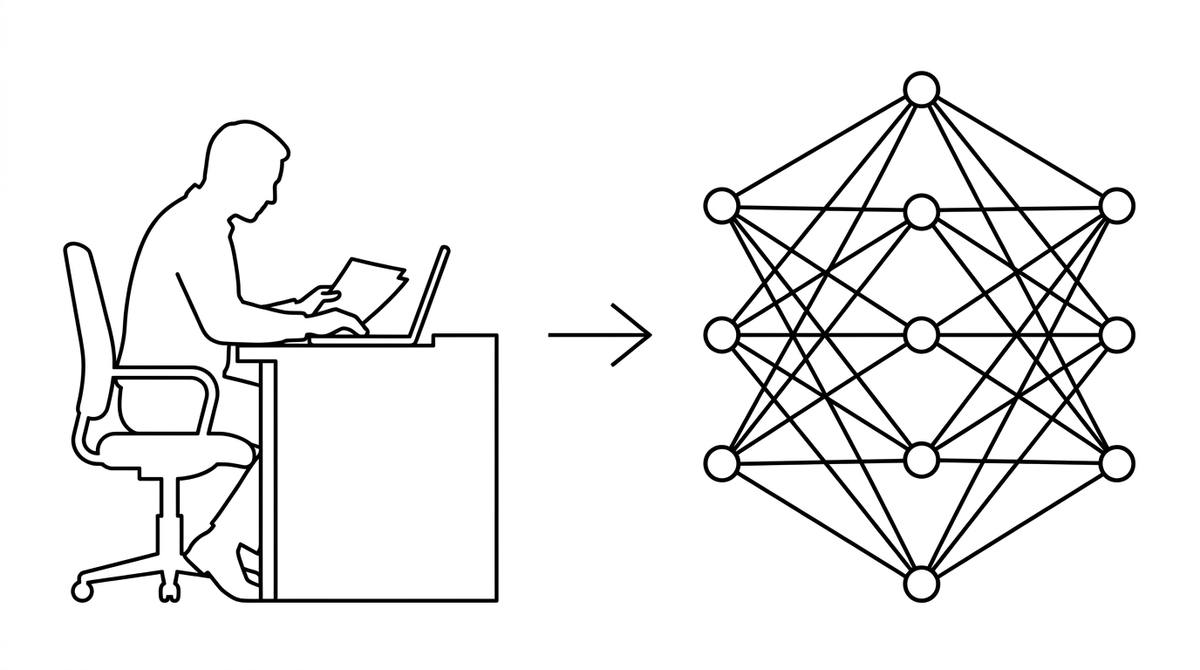
An AI operations backbone is not a chatbot. It is not ChatGPT with a company prompt. It is a **purpose-built system of five interconnected AI modules**, each handling one CTO function, running in production 24/7, and feeding decisions to the humans who act on them.
Think of it as the nervous system your company does not have. It does not make the final call — the founder or the operations director does. But it prepares the decision, surfaces the data, flags the risk, and recommends the action. **The human decides. The AI does the homework.**
The five modules are: vendor evaluation, architecture monitoring, code quality assurance, security posture management, and cost optimization. Each one replaces a specific slice of what a CTO does every week — and each one runs at a fraction of the cost of the human equivalent.

The five functions it replaces
**Function 1: Vendor evaluation.** Every quarter, your company evaluates a new tool, a new SaaS, a new service provider. Today, the founder asks around or trusts the vendor's pitch. An AI vendor evaluation module ingests your requirements, compares options against public benchmarks, checks reviews, calculates total cost of ownership, and produces a written recommendation. Time saved: 20 to 40 hours per evaluation.
**Function 2: Architecture monitoring.** Your existing systems — ERP, website, internal tools — drift over time. Performance degrades, dependencies go stale, security patches pile up. An AI architecture monitor runs weekly scans, flags the top three risks, and recommends specific actions. No human CTO does this consistently — even the good ones forget.
**Function 3: Code quality assurance.** If your company ships software (internal or external), every pull request should be reviewed. An AI code review module runs static analysis, checks for OWASP vulnerabilities, flags anti-patterns, and produces a review summary that a junior developer can act on. **Not a replacement for a senior engineer's judgment — but a replacement for the senior engineer's time on routine reviews.**
**Function 4: Security posture management.** Continuous monitoring of your attack surface — exposed ports, outdated SSL certificates, misconfigured cloud permissions, leaked credentials on GitHub. An AI security monitor runs daily and escalates critical findings to the founder's WhatsApp. Most Algerian SMEs have zero security monitoring today.
**Function 5: Cost optimization.** Cloud bills, SaaS subscriptions, hosting fees, vendor contracts — an AI cost module tracks all technology spending, flags waste, and recommends downgrades or cancellations. The average Algerian SME overspends on technology by 15 to 25 percent because nobody audits the bills.
What it cannot do — and where you still need humans
An AI operations backbone does not replace strategic thinking. It does not decide whether your company should build a marketplace or stay with direct sales. It does not negotiate with a ministry. It does not fire an underperforming vendor in a way that preserves the relationship. It does not sit in a board meeting and explain why the migration will take six months instead of two.
**Every decision that involves human judgment under ambiguity — politics, negotiation, long-term strategy, team dynamics — stays human.** The backbone handles the 60 percent of CTO work that is routine, repeatable, and data-driven. The 40 percent that requires a human still requires a human. But now that human only needs to spend 40 percent of their time on it, not 100 percent.
In practice, this means the founder or the operations director becomes a **part-time CTO augmented by the AI backbone**, instead of a full-time non-technical person making technical decisions blind.
How to build one — and what it costs
An AI operations backbone for an Algerian SME is not a single product you buy. It is a **system we build from existing components**, customized to your stack, your vendors, your processes. The five modules use a combination of LLM APIs (for text analysis and recommendation), monitoring tools (for infrastructure and security scanning), and custom integrations with your existing systems.
**Timeline: 8 to 12 weeks** from kickoff to all five modules running in production. We start with the module that has the highest immediate ROI for your company — usually vendor evaluation or security monitoring — and add the others incrementally.
**Cost: between 3 and 8 million dinars** for the initial build, plus 200,000 to 500,000 dinars per month for the AI API costs and maintenance. Compare that to a senior CTO at 400,000+ dinars per month who takes six months to find and may leave after eighteen months. **The backbone does not leave. It does not take vacation. It does not get poached by a competitor.**
The ROI is direct and measurable: the first vendor evaluation the backbone runs typically saves more than its monthly operating cost. The first security scan typically finds vulnerabilities that would have cost millions to fix after an incident. The cost optimization module typically recovers 10 to 20 percent of the technology budget within the first quarter.